
LED wall vs projector: which belongs at your event?
Projection looks cheaper on a quote and then loses badly in a lit ballroom. Here is the honest comparison — including the events where a projector is still the right call.
The one difference that decides most events
A projector throws light onto a surface. An LED wall is the light source. Everything else follows from that.
Because a projector relies on reflected light, every other light in the room competes with it. Turn up the chandeliers for a plated dinner, put a wash light on the stage so the speaker is visible on camera, open a door to a lit corridor — each one lifts the black level of the projected image and drains the contrast. The picture does not just get dimmer, it gets flatter and grayer.
An LED wall does the opposite. It emits its own light at 800–1,500 nits indoors, so the picture stays saturated with the room lights at full. You are not asking your guests to eat dinner in the dark so the screen works.
Straight comparison
| LED video wall | Projector & screen | |
|---|---|---|
| Room lighting | Full house lights, no compromise | Needs dimmed or controlled light |
| Contrast | True blacks, high saturation | Blacks are only as dark as the screen surface |
| Throw distance | None — the wall is the picture | Needs clear throw, or an expensive short-throw lens |
| People walking through it | Impossible to block | Shadows across the image |
| Shape and size | Modular — any width, height, curve or column | Fixed screen sizes and ratios |
| Ceiling height | Ground support base plus screen height | Screen height plus rigging or a tripod frame |
| Setup time | Around 90 minutes for a single wall | Fast for a small screen, slow for a large rig |
| Looks like | Part of the set design | Visibly AV equipment |
| Cost | Higher day rate | Lower day rate, more room compromises |
Where an LED wall clearly wins
- Weddings and galas — the room stays lit, the montage still reads, and the wall photographs as part of the decor rather than as equipment.
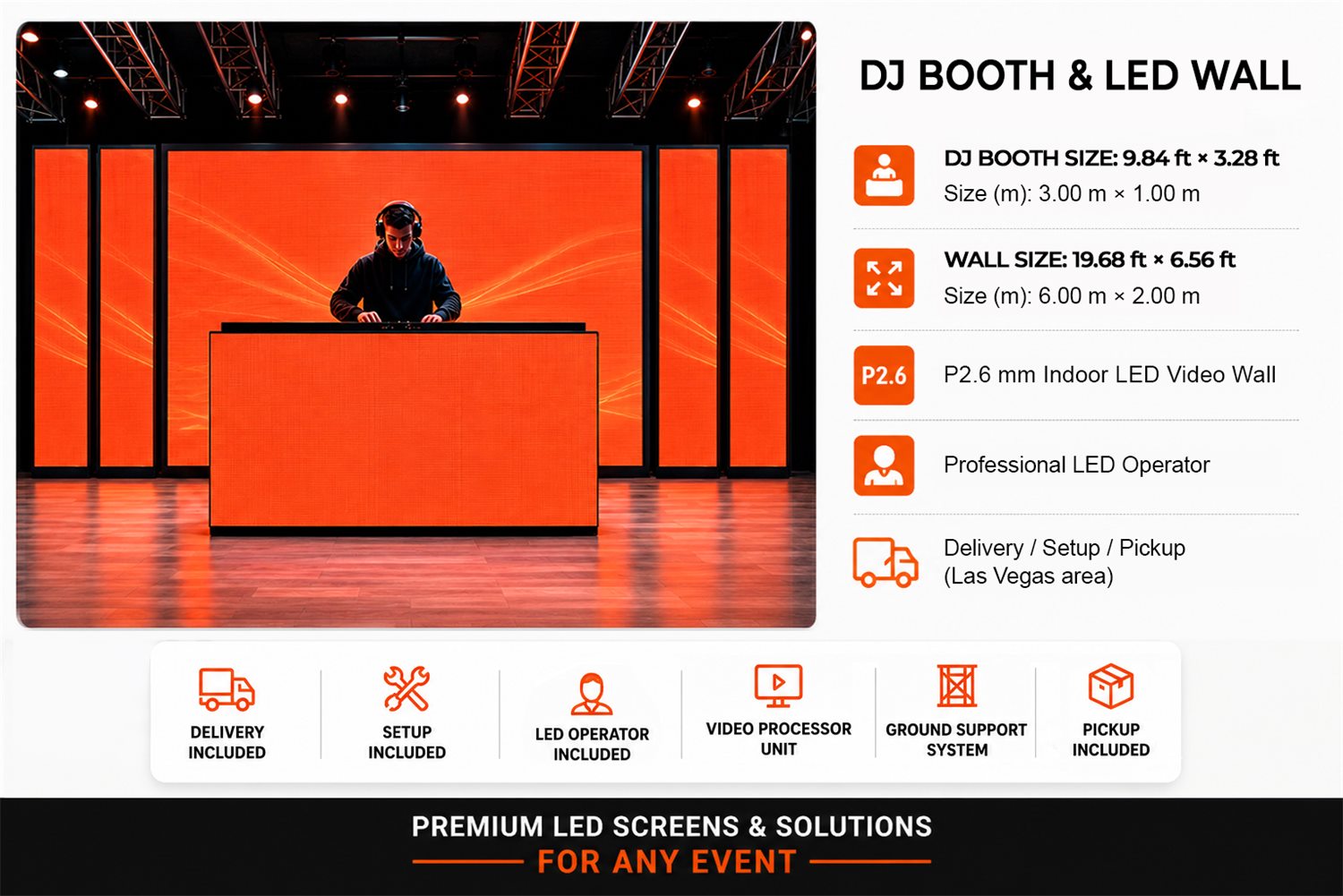
- DJ booths and dance floors — content wrapping a booth front and the wall behind it is simply not something projection can do.
- Trade show booths — convention halls are brightly lit by definition, and a booth has no throw distance to give away.
- Anywhere people cross in front of the picture — a presenter walking a stage, a bride and groom entering, a runway.
- Odd shapes — a bar front, a ceiling piece, a curved backdrop, a wall cut around a doorway. Panels are modular; a projection screen is a rectangle.
Where a projector is still the right answer
We rent LED walls, so treat this section as the part we have no incentive to write.
- A genuinely dark room — a screening, an awards film, a theater. Projection in the dark looks excellent and costs less.
- Very large images on a tight budget — a 10 m wide projected image is far cheaper than 10 m of LED. If the audience is far back and the room is dim, that trade can be right.
- Architectural projection mapping — projecting onto a building facade, a cake, a car or a textured surface. An LED wall cannot do that at all.
- Simple slide support in a small meeting room — forty people and a deck does not need an LED wall.
The cost comparison people get wrong
Comparing day rates alone flatters projection. The comparison that matters includes what each option forces on the rest of the event:
- A projector large enough for a ballroom needs serious brightness, and high-lumen projectors with the right lens are not cheap.
- You need a screen and its frame or rigging, plus the drape kit to dress it.
- You may need to re-plan the lighting design around the screen, or accept a dimmer room.
- You lose floor space to the throw, or pay for a short-throw lens to get it back.
- If a photographer or videographer is covering the event, a washed-out projection is visible in every wide shot — and those images are what the event is remembered by.
Add those up and the gap narrows considerably. For a wedding or a corporate dinner it often disappears entirely.
How to decide in one question
Ask: will the room lights be on?
If yes — dinner, dancing, a networking reception, an exhibition floor — you want an LED wall, and the rest of the discussion is about what size. If the room will genuinely be dark for the whole time the screen matters, projection deserves a serious look.
Most Las Vegas events fall into the first group, which is why the city runs on LED. If you are unsure which yours is, send us the schedule and the venue. We will tell you honestly, including when the answer is a projector.