
Why white speakers look better in a ballroom
Almost every PA system in the world is black, and in a light ballroom it is the most conspicuous object in the room. Here is the case for white cabinets at weddings, galas and corporate events — and the occasions black still wins.
Why audio is black in the first place
Touring production is black because it works in a dark room. On a concert stage the goal is for the audience to see the light and not the equipment producing it, so every cabinet, every stand and every case is matte black and disappears into the dark.
That logic is sound, and it is why the industry standardized on it. It is also why black became the default in rooms that are nothing like a concert stage.
A ballroom is the opposite room
Wedding and corporate venues in Las Vegas are light. Cream walls, gold detail, pale drape, chandeliers, white linen, mirrored surfaces. Bring black boxes into that and they become the highest-contrast object in the frame.
Put four black speaker cabinets at the front of a white ballroom and your eye goes to them first, every time.
Speakers are the piece you cannot hide
This is the part that matters, and it is specific to audio.
Most production equipment can be dressed out of the way. Lighting fixtures go overhead, where nobody is looking. Cabling is taped and skirted. A stage deck gets a skirt around it. A video processor lives on a table behind a drape.
Speakers cannot. They only work if they are in the open, pointed at the audience, at roughly head height or above — on stands flanking the dance floor, or flown either side of the stage. There is no drape you can put in front of a speaker, because the drape would defeat the speaker.
So of everything a rental company brings into your room, the PA is the one item guaranteed to be visible in the wide shots. That is why we changed the color of that specifically.
The photographs are the point
An event lasts one evening; the photographs last considerably longer, and they are what the client, the brand or the couple actually keep.
In a wide shot of a wedding reception, black cabinets flanking the dance floor are permanent dark blocks in the composition. A photographer can shoot around them, but only by choosing angles they would not otherwise have chosen — and at some point in the evening they will need the wide shot anyway.
In the same frame with white cabinets, the speakers simply do not draw the eye. They read at roughly the same value as the walls and the linen. The picture is the room, the guests and the flowers, which is what everyone wanted.
Where it makes the most difference
- Weddings — light rooms, formal photography, and a couple who care how the room reads. The clearest case by far.
- Galas and fundraisers — a designed room with a color palette, and a photographer covering the whole evening.
- Corporate events and product launches — a brand has spent real money on a look, and a stack of road-worn black boxes is not in the brief.
- Conferences and panels — a speaker cabinet either side of a light set is the one thing the set designer could not account for.
- Trade show booths — exhibition halls are lit hard and bright, and black kit reads as back-of-house.
The other thing white does: it takes color
A white surface reflects whatever you put on it. Wash the room in amber and the cabinets go amber with it. Push deep blue across the floor and they read blue. Black absorbs the light and stays black no matter what your lighting rig is doing.
So as the color scheme moves through the evening — warm for dinner, saturated for dancing — the PA moves with it instead of sitting there as a fixed dark mass.
When black is still right
Two honest exceptions.
A genuinely dark room. A theater, a concert, a screening, a nightclub. Here the original logic holds: black disappears, and white cabinets would catch every beam that clipped them.
A dark or high-contrast set design. If the designer has built a black box on purpose, white audio breaks it. Design intent beats a general rule.
For the events we mostly work on in Las Vegas — weddings, conferences, galas, corporate parties and trade shows — those exceptions are rare.
What white costs
Nothing on the rate, and something in the maintenance. White shows every scuff, so white cabinets have to be cleaned, touched up and retired sooner than black ones would be. That is our problem rather than yours, and it is the reason most rental houses do not bother.
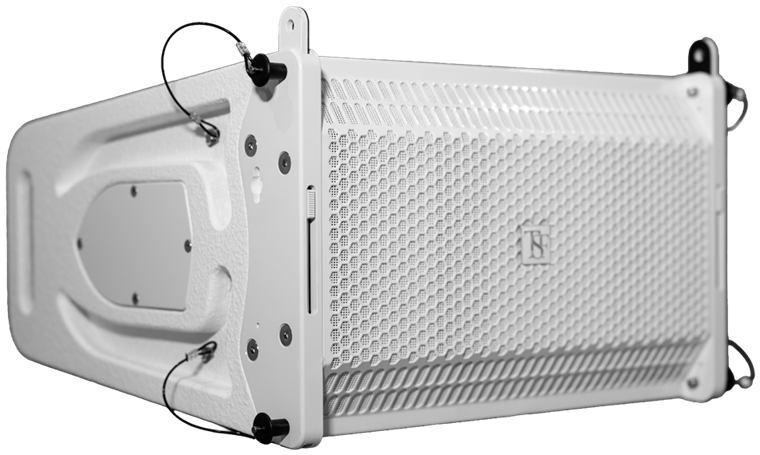
Our line array mains, subwoofers and stage monitors are all white. Not as a gimmick — because the rooms we work in are light, the speakers are the one thing that cannot be hidden, and the photographs come out better for it.
One thing white must never cost is the sound. Sound quality matters to us more than the finish does, so the cabinets are high-grade boxes manufactured in China to a professional touring standard, and every one of them is loaded with drivers from LaVoce Italiana, the renowned Italian transducer house whose woofers and compression drivers are found in some of the most respected PA systems in the world. The white is for the photographs. The drivers are for the room.