
How much does an LED wall rental cost in Las Vegas?
It is the first question everyone asks and the one most rental companies refuse to answer. Here is what actually drives the price of an LED video wall in Las Vegas, the ranges you should expect for the common event types, and the lines that should be on the quote before you compare two of them.
The short answer
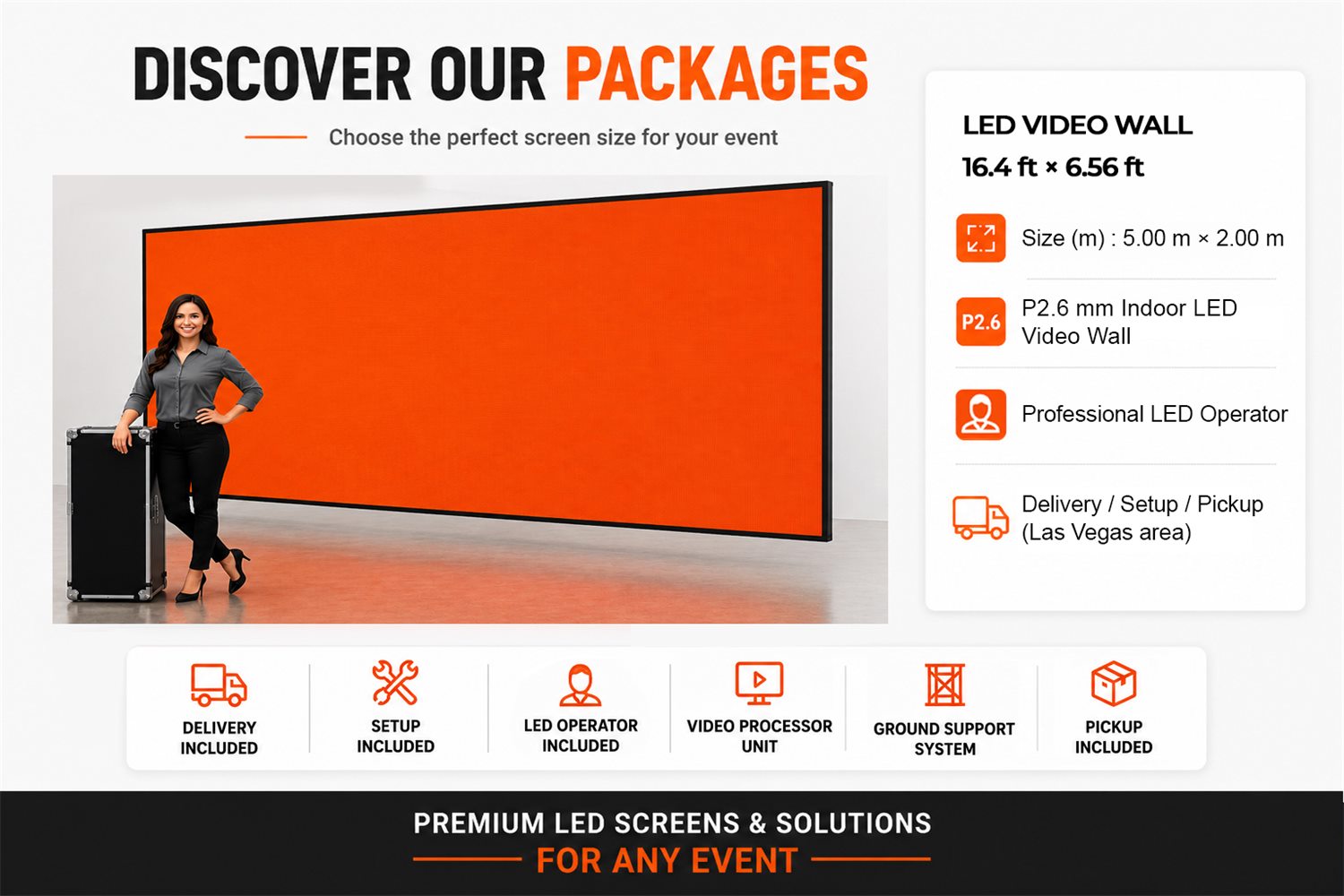
In the Las Vegas market, a small indoor LED wall — around 3 × 2 m, delivered, built, operated and struck for one event day — typically lands in the low-to-mid thousands of dollars. A mid-size wall of 5 to 7 m behind a stage or a DJ booth runs higher. A large, curved or multi-surface build for a convention booth goes well past ten thousand, and the published rates of the big trade show houses in town start there.
We quote per room, same working day, with the layout and the power requirement on the same page. Send the venue, the date and roughly what you picture and you will have a real number rather than a range.
The reason nobody publishes a single price is not secrecy. It is that two walls of the same size can cost very different amounts depending on the five things below.
The five things that drive the price
1. Size
LED walls are built from modular panels, and the price scales with the number of panels. A 3 × 2 m wall is six square meters; a 7 × 2 m wall is fourteen. Height is the expensive direction, because every extra row needs more ground support and more build time. Our sizing guide shows how to pick the smallest wall that still reads from the back of the room.
2. Pixel pitch
Finer pitch means more LEDs per panel and a higher rental rate. P2.6, which we run, is the right pitch for an indoor event where guests stand close. P3.9 is cheaper and fine for a stage viewed from 10 m away; P1.9 is a convention-booth pitch that costs considerably more and that a wedding will never notice. Pixel pitch explained.
3. What is in the box
This is where quotes diverge. Some Las Vegas companies price the panels and then add the video processor, the ground support, the delivery, the installation labor, the operator and the strike as separate lines. Some include all of it. The panel rate looks cheap until the total arrives. See what should be included.
4. The venue
A Strip hotel ballroom with a 20-minute dock window and union labor costs more to load into than a country club with a side door. Some convention venues require in-house rigging or charge for power drops. None of this is the rental company's choice, but it lands on the quote, which is why the venue name is the first thing we ask for.
5. Days and distance
Most walls are priced per event day. A multi-day conference costs more than a Saturday wedding, but not by a multiple: the build and strike happen once. Inside the Las Vegas valley we charge no travel; outside it, mileage and crew time are added.
Typical ranges by event type
These are market ranges for Las Vegas, delivered and operated, to help you budget. They are not a price list; the actual quote depends on the room.
| Event | Typical build | Where it lands |
|---|---|---|
| Wedding reception | 3 × 2 m wall behind the dance floor, often with an LED DJ booth | Low-to-mid thousands |
| Bar / bat mitzvah, quinceañera | LED DJ booth plus a 4.5 to 6 m wall, portrait columns for photos | Mid thousands |
| Corporate dinner or awards | 5 × 2 m or 5 × 3 m wall behind a stage deck | Mid thousands |
| Conference general session | 5 × 3 m main screen, confidence monitors, multi-day | Mid-to-high thousands |
| Trade show booth | Custom shape, fine pitch, hall labor and power | High thousands and up |
If a quote comes in far below these ranges, check what has been left out. If it comes in far above, ask what the extra buys.
What should be included
Compare totals, and make sure each of these is on every quote you look at:
- Delivery and strike — the truck both ways, and the crew to load in and out.
- Installation labor — a 3 × 2 m wall is about 90 minutes of build; a booth with a wall behind it, two to three hours.
- The LED video processor — the box that scales and switches your content. Without it the wall is a pile of panels.
- Ground support — the structure the wall stands on. Flying from the ceiling costs more and many venues forbid it.
- An operator — someone who loads your content, switches sources and fixes a failed tile during the event. We include one on every LED package; many quotes do not.
- Spare panels — so a dead tile is swapped in minutes rather than becoming your problem.
- Insurance — a certificate naming the venue. Most Las Vegas hotels require it before load-in. More on venue paperwork.
How to make it cheaper without making it worse
- Go wide, not tall. A 5 × 2 m wall is cheaper to build than a 3 × 3 m one and reads better in most rooms.
- Use the right pitch. P2.6 indoors. Paying for P1.9 at a wedding is money nobody at the party will see.
- Put the wall behind a stage deck instead of on a taller base. It fixes sightlines and the deck does double duty for the presenter or the head table.
- Send content ahead. Content built on the night costs operator hours. Content tested the week before costs nothing extra.
- Book the sound and lighting on the same truck. One crew, one load-in, one certificate of insurance. Ours are white, which photographs better in a Las Vegas ballroom.
Is a projector cheaper?
On paper, yes. In practice a projector in a lit ballroom or an exhibition hall loses the picture, so the real comparison is an LED wall against a projector plus a darkened room plus the photographs that come out of a darkened room. For a screening or a dark theater, projection is fine. For anything lit or photographed, LED wins, and the difference in price is smaller than it looks once the projection rig is specified properly. The full comparison is in LED wall vs projector.
The fastest way to a real number is still the venue name, the date and the guest count. We reply the same working day.